I know the story, but I ramble.
Practice feedback flags missing structure, restarts, filler words, and where the answer runs long.
Write your stories, record yourself telling them, and get AI feedback on what to fix.

You may have the right background and still lose the room if the answer is vague, too long, or not tied to the role.
Practice feedback flags missing structure, restarts, filler words, and where the answer runs long.
Evidence grounding compares what you said against the details saved in your story and profile.
Story prep ties each answer to specific context, decisions, tradeoffs, and outcomes from your work.
Turn work you have already done into prepared answers for behavioral questions. One story covers a whole set of prompts, and you adapt it for the company, role, and round.
Real context and the constraint that made the work hard.
What you chose, what you traded off, and why.
Numbers before and after, not a vague improvement.
About two minutes, without restarts or filler.
Situation: New teams onboarding to an internal BI product took about nine days to reach their first real insight, and many went dormant before they got there.
Task: Lift 30-day activation by getting teams to value faster, not by adding more onboarding surface, which earlier attempts had already tried.
Action: Reframed onboarding around time to first value, instrumented the funnel to find where teams stalled, and rebuilt the first run around the shortest path to one useful insight. The feature tour became a guided setup checklist with contextual nudges, validated by experiments before it shipped to everyone.
Result: 30-day activation moved from 41% to 46% and time to first value dropped from nine days to three, which made activation the most reliable retention lever the team had.
Situation: The activation funnel had several plausible fixes and no way to tell which one actually worked, so a single large redesign would have been a blind bet.
Task: Improve activation with evidence instead of one big unvalidated change, and leave the team a repeatable way to keep improving it.
Action: Ran a continuous experiment cadence across the funnel, covering empty states, the setup checklist, and contextual nudges. Shipped more than 20 A/B tests, cut the losers quickly, and folded only the winners into the default new-account experience so the gains compounded.
Result: The funnel work drove the 30-day activation lift from 41% to 46%, and the experiment cadence became the standard way the team evolved onboarding.
Situation: The weekly release train kept slipping because the regression suite took two days to run by hand, and flaky tests made every red build ambiguous.
Task: Restore release confidence without freezing the roadmap and without adding manual testers.
Action: Split the suite into a fast smoke set that ran on every pull request and a deep nightly set. Rewrote the flakiest specs against stable selectors and seeded data, and added a quarantine rule so a known-flaky test could not block a release while it was being fixed.
Result: Regression feedback went from two days to about 40 minutes, flaky failures fell from roughly one build in four to under one in twenty, and the team shipped weekly again with fewer defects reaching production.
Situation: Checkout was timing out at peak traffic and the on-call rotation was absorbing several alerts a week with no clear cause.
Task: Make checkout hold up under peak load without the rewrite the team had no room for.
Action: Traced the slow path and found most of the latency in repeated database calls behind one endpoint. Added request-level batching, moved non-urgent work to a queue, and put a cache in front of the read path with explicit invalidation. Shipped behind a flag and ramped by percentage while watching latency.
Result: p95 checkout latency went from 3.2 seconds to 700 milliseconds, peak timeouts stopped, and alerts for the service dropped to about one a month.
Situation: Two teams needed the same customer data and each wanted to own the service. The debate had been open for a month while both roadmaps waited.
Task: Reach a decision the other team would actually support instead of winning the argument.
Action: Wrote both designs down with the tradeoffs each team cared about, ran a short spike to test the contested assumption about write volume, and took the result to a joint review. The data favored their ownership model, so I said so and offered to build the migration path from our side.
Result: Ownership was settled in a week, the migration shipped without a code freeze, and the written tradeoff format became how both teams opened design debates after that.
Job Seeker OS uses your saved experience, resume evidence, and story bank to prepare for the specific role. The same facts that shape the resume become the answers you practice before the call.
 Interview prep · Senior PM Platform
Likely question
Tell me about a time you led a platform migration under risk.
Matched story
Payments rebuild with zero downtime
Proof: 4M monthly transactions · 99.95% uptime · checkout failures down 38%.
Watch-outs
Question to ask
What platform reliability tradeoffs has the team had to make in the last year?
Teleprompter
The risk was not the migration itself; it was losing trust during checkout. I aligned product, engineering, and support around one release plan...

Video or audio
AI feedback preview
Structure
Pass
Metric
Concern
Concise
Pass
Practice the answer the way you will actually deliver it. Record a take, use the saved story as a teleprompter, and get feedback on what you actually said.
Each round asks a different question underneath the question. Prepare the likely prompts, the proof to use, the watch-outs to avoid, and the questions you should ask back.
| Round | What the prep should help with |
|---|---|
| Recruiter | Positioning, motivation, logistics, compensation boundaries. |
| Hiring Manager | Role fit, operating style, execution proof, relevant decisions. |
| Panel | Consistent stories, collaboration, tradeoffs, stakeholder signal. |
| Executive | Judgment, business impact, leadership signal, why this company now. |
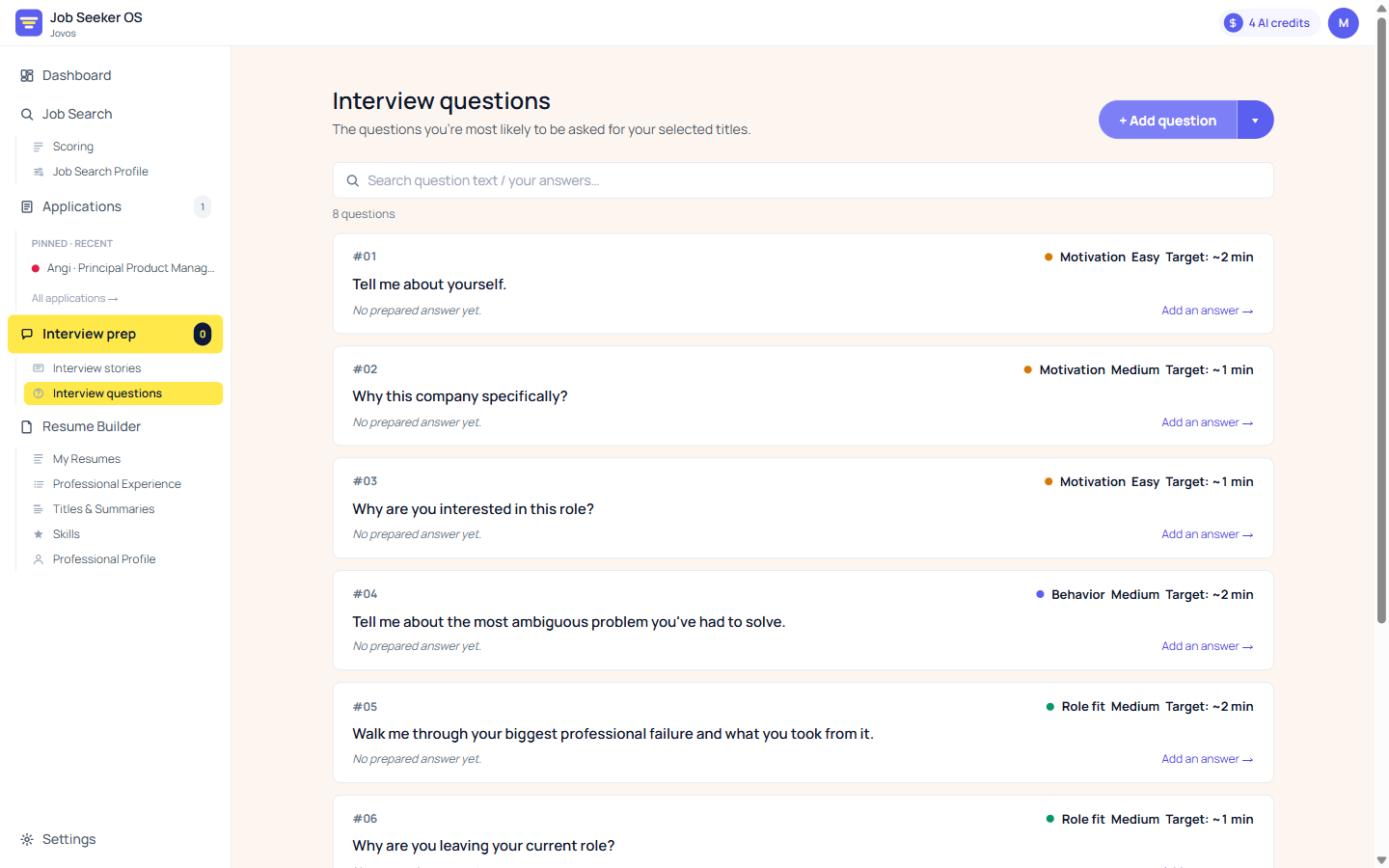
Job Seeker OS interview prep helps you prepare for interviews from your own career evidence. It can organize likely questions, match stories to the role, help you practice answers out loud, and give AI feedback on the transcript.
No. Behavioral stories are a core part of the system, but the workflow also supports recruiter screens, hiring-manager rounds, panel rounds, executive conversations, questions to ask, watch-outs, and post-round improvement.
Generic tools usually start with a question and a blank answer. Job Seeker OS starts with the role and your verified experience, so the prep is tied to the job, your resume evidence, and the stories you can actually defend.
It can help structure and improve your answers, but the answers should come from your real experience. The product should not invent achievements, employers, dates, or metrics.
Yes. You can record a take, use your saved story as a teleprompter, and get feedback on the transcript, including structure, specificity, concision, delivery patterns, and consistency with your saved evidence.
Recordings are private to you. You can delete takes yourself, and recordings auto-delete on a retention window while transcripts and feedback can remain available so you can keep improving.
AI feedback is available through hosted AI credits when available, or through your own API key in bring-your-own-key mode. The page should not imply unlimited free review.
Build your story bank, prepare for the role, and practice the answers that need to land. Start with a free workspace.